Firelight Media Announces 10 Filmmakers Selected for 2026–2027 Documentary Lab Fellowship
The latest cohort will receive $25,000 project grants, individualized mentorship and professional support to advance documentary films in post-production.
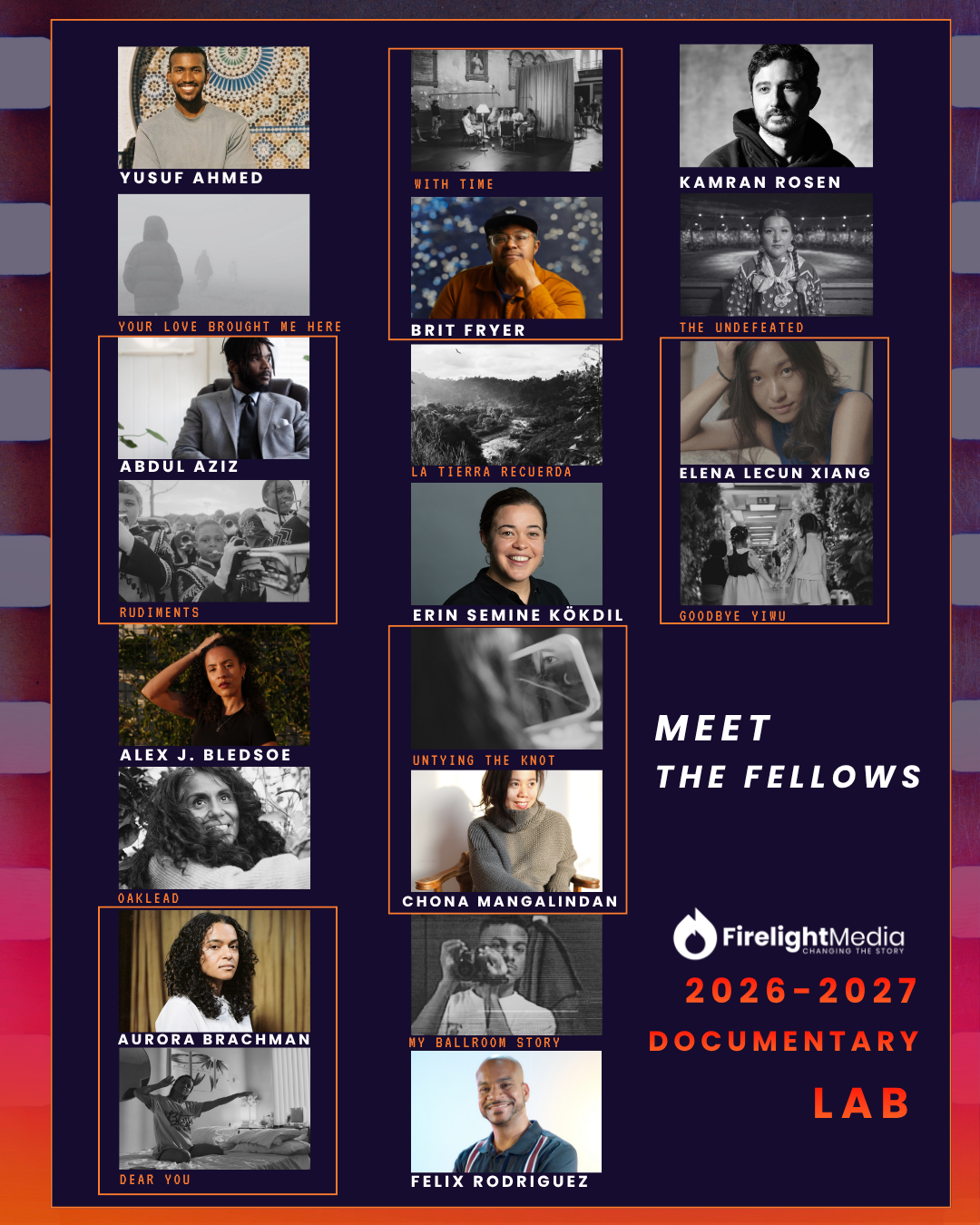
The latest cohort will receive $25,000 project grants, individualized mentorship and professional support to advance documentary films in post-production. The fellowship is designed to help independent filmmakers strengthen their projects and move closer to completion. Through financial assistance and industry connections, Firelight Media continues its commitment to supporting underrepresented voices in nonfiction filmmaking.
Firelight Media has announced the 10 filmmakers selected for its 2026–2027 Documentary Lab, the nonprofit organization’s longest-running artist program. Chosen from a pool of more than 140 applicants, the fellows will receive $25,000 project grants, customized mentorship from leading documentary professionals, professional development opportunities, artist retreats and networking support. These resources will help the filmmakers refine their work and navigate the challenges of completing independent documentary projects.
For the first time in the program’s history, this year’s Documentary Lab accepted applications exclusively from projects in post-production. The shift reflects the increasingly challenging funding and distribution landscape facing independent documentary filmmakers. By focusing on projects at a similar stage, the program aims to provide targeted support when filmmakers need it most.
Through the 12-month fellowship, Firelight Media aims to help participating filmmakers strengthen their stories, receive substantive project feedback and build momentum toward completing their films. The program will prioritize artistic development and constructive feedback tailored to each project’s needs. This approach is intended to help fellows overcome obstacles and prepare their documentaries for audiences.
“The films they bring to the Lab are united by themes of resistance, belonging, and liberation through self-determination,” said Lu Mukerjee, director of the Documentary Lab. “The focus of this year’s Lab is to serve as a bridge for films in post-production, providing the artistic, professional, and financial resources these filmmakers need to bring their projects closer to completion.” Mukerjee also expressed confidence that the selected films would resonate with the communities they were made for and reach wider audiences across the documentary industry.
The 2026–2027 cohort brings together a diverse range of nonfiction projects exploring family, cultural preservation, environmental justice, gender identity, Indigenous sovereignty and the pursuit of personal freedom. The films examine how individuals and communities respond to systemic barriers, preserve their histories and seek greater control over their futures. Together, they reflect the Documentary Lab’s commitment to supporting stories that offer perspectives often underrepresented in mainstream media.
In Your Love Brought Me Here, filmmaker Yusuf Ahmed follows his family from Ohio across the mountains of Hararghe in eastern Ethiopia, searching for the grave of his father, who was taken from his home 30 years earlier. The film explores family history, displacement and the enduring search for answers across generations. Abdul Aziz’s Rudiments examines the power of mentorship, Black excellence and cultural preservation through a marching band that offers young people a path forward amid systemic disinvestment in Black communities.
Environmental justice and the legacy of racial inequality are central to Alex J. Bledsoe’s Oaklead, a feature-length documentary examining the ongoing pediatric lead-poisoning crisis in Oakland, California. The film confronts the consequences of more than a century of environmental racism and the continuing fight to protect children from lead exposure in homes and schools. Meanwhile, Erin Semine Kökdil’s La Tierra Recuerda (The Earth Remembers) follows the Indigenous Maya Poqomam community of Santa Cruz Chinautla, Guatemala, as residents fight environmental destruction and work to protect their land, culture and future through women-led activism and ancestral knowledge.
Other projects examine the personal costs of restrictive social and legal systems. Aurora Brachman’s Dear You offers a poetic portrait of Grace James, who fled an abusive marriage and spent a decade navigating the U.S. asylum system. As James remains caught in legal limbo, memories of her former life in Kiribati, the Pacific island nation where she grew up, begin to resurface. In Untying the Knot, Chona Mangalindan follows three women in the Philippines seeking to leave marriages they can no longer endure, amid a legal system that does not permit divorce. The film also follows an 82-year-old lawmaker pushing for legislative change in the face of powerful religious opposition.
The experiences of queer and trans communities feature prominently in the cohort. Brit Fryer’s With Time documents a storytelling workshop for trans participants aged 50 and older, inviting them to reflect on gender euphoria, community and moments of self-recognition. Through improvisation and discussion, participants develop narrative scripts based on significant memories that shaped their relationships with queerness and belonging. Felix Rodriguez’s My Ballroom Storyrevisits the filmmaker’s footage of the 1990s ballroom scene, exploring internalized homophobia, family expectations, healing and self-acceptance through the perspective of an Afro-Latino filmmaker in his 50s.
In The Undefeated, Kamran Rosen follows three Native youth athletes who use sports to reclaim Indigenous cultural identity and inspire pride in their communities. The film considers this cultural resurgence against a history of efforts to suppress Native languages, religions and traditions. Elena Lecun Xiang’s Goodbye, Yiwu (working title) returns to the filmmaker’s childhood home in Yiwu, China, a global center of small-commodity trade, where she films a Pakistani working mother and her son. Through their experiences, Xiang examines the hidden sacrifices of motherhood while confronting the emotional legacy of her own childhood spent apart from her mother.
Together, the films reflect the Documentary Lab’s emphasis on stories rooted in lived experience, community histories and the pursuit of greater agency over personal and collective futures. Their subjects span continents and generations, connecting deeply personal experiences with broader social and historical forces. The cohort underscores the role of documentary filmmaking in preserving cultural memory, challenging injustice and creating space for underrepresented perspectives.
The decision to limit this year’s applications to projects in post-production marks a significant change in the Documentary Lab’s approach. By bringing together films at a similar stage, Firelight Media can concentrate its resources on story development, editorial feedback and professional connections. The program is designed to address the specific needs of filmmakers working to complete their projects in a difficult funding and distribution environment.
The fellows were selected through a review process involving a dedicated selection committee, followed by final decisions from an advisory board of documentary industry leaders. The board included Opal H. Bennett, senior producer at POV and executive producer of POV Shorts, and Jannet Nunez, a producer and film consultant. Independent filmmakers Felix Endara, Jacqueline Olive and Steve Maing also served on the advisory board, bringing a range of experience and perspectives to the selection process.
Over the past 16 years, Firelight Media has supported 170 filmmakers through the Documentary Lab as part of its broader mission to make the nonfiction film industry—and public media in particular—more representative of the audiences it serves. The program provides filmmakers with resources and professional relationships that can help sustain their work beyond a single project. Its focus on mentorship and artistic development also supports the growth of a more inclusive documentary community.
The program’s alumni have earned recognition at major festivals and industry awards. Adam and Zack Khalil, co-directors of Aanikoobijigan [ancestor / great-grandparent / great-grandchild], won the NEXT Audience Award at the 2026 Sundance Film Festival. Brittany Shyne received the U.S. Documentary Grand Jury Prize at the 2025 Sundance Film Festival for Seeds, while Contessa Gayles’ documentary visual album Songs from the Hole won a 2026 News & Documentary Emmy Award for Outstanding Art Direction. These achievements highlight the work of filmmakers who have benefited from Firelight Media’s broader commitment to supporting distinctive nonfiction storytelling.
Founded to support, resource and advocate for documentary filmmakers of color, Firelight Media celebrated its 25th anniversary in 2025. The organization works to expand opportunities for Black, Brown and Indigenous filmmakers and to help their stories reach audiences. Its programs combine financial assistance, professional development and industry advocacy to address barriers within the nonfiction film sector.
In addition to the Documentary Lab, the organization operates the Firelight Fund, which supports Black, Brown and Indigenous stories from development through distribution and impact. It also administers the William Greaves Research & Development Fund for mid-career filmmakers. Together, these initiatives support artists at different stages of their careers and help strengthen the infrastructure for independent documentary production.
Firelight Media’s work also extends to digital storytelling and public media. Its projects include the HOMEGROWN: Horizons collection for PBS Digital Studios and the fourth season of In the Making, produced with PBS’ American Masters. These initiatives expand opportunities for filmmakers to share their perspectives through different formats and platforms.
With its newest Documentary Lab cohort, Firelight Media continues to invest in filmmakers whose work challenges dominant narratives, preserves cultural memory and brings underrepresented perspectives to the screen. By pairing direct financial support with sustained mentorship and industry access, the organization is helping the 10 selected projects advance from post-production toward completion and wider distribution. The fellowship reinforces Firelight Media’s longstanding commitment to building a more representative documentary industry and ensuring that a broader range of stories can reach audiences.
For more information, visit Firelight Media.


